The Fabric of Knowledge
Understanding how Fabric, Weaves, Looms, and Threads compose the Codex—so superintelligence can traverse across weaves and synthesize knowledge as a whole.
Weave: The Universe
A weave is the highest-level container. It represents a complete, self-contained knowledge domain. Within each weave, multiple looms organize related content into coherent collections.
Weave
A complete universe of knowledge. Self-contained, comprehensive collections that form the top-level organization.
Loom
Curated collections within a weave. Groups related threads by topic, purpose, or theme.
Thread
Individual knowledge units. Documents, guides, references—the atomic building blocks of the codex.
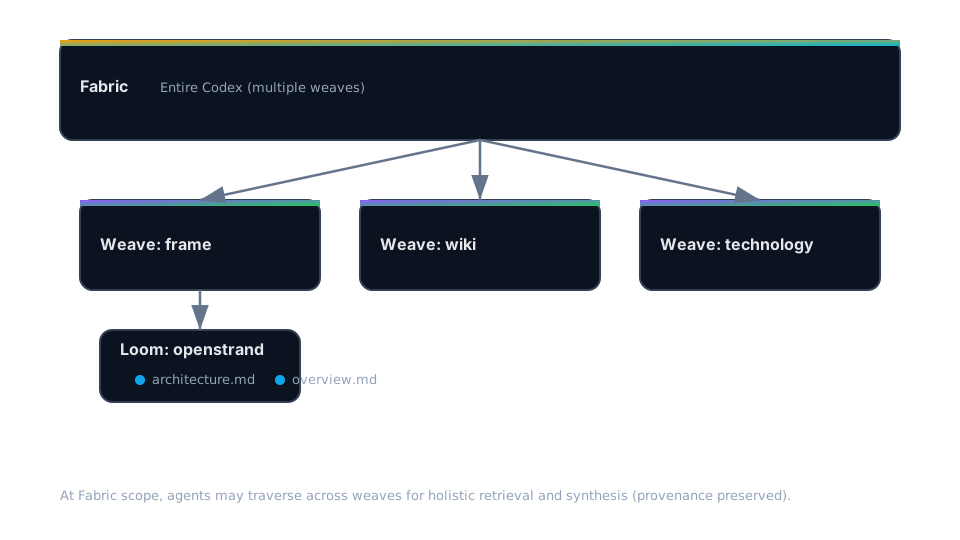
The Hierarchy
Quarry uses a simple yet powerful four-tier hierarchy to organize all knowledge. Each layer serves a specific purpose and enables different types of relationships and queries.
Fabric: The Whole
A Fabric is a collection of weaves—an entire knowledge corpus viewed as one living whole. The Quarry itself is a fabric. Operating at fabric scope allows agents and superintelligence to move seamlessly across weaves, aggregating and synthesizing information holistically.
fabric: Quarry
├─ weave: research     (Papers and reading notes)
├─ weave: wiki         (Meta-docs, governance)
└─ weave: technology   (Technical knowledge)
Superintelligence Mode: At fabric scope, retrieval and reasoning can traverse any weave boundary with provenance preserved.
Weave: The Universe
A Weave is a complete, self-contained knowledge universe. Think of it as a separate dimension where all knowledge is related, but nothing connects to other weaves.
weaves/
  research/       ← Research weave
    weave.yaml
    looms/
      reading-list/
      experiments/
  science/        ← Separate science weave
    weave.yaml
    looms/
      physics/
      biology/
Key Rule: No relationships exist between different weaves. This ensures clean boundaries and prevents knowledge pollution.
Loom: The Collection
A Loom curates related threads into a cohesive topic or learning path. It defines how threads connect and in what order they should be consumed.
slug: getting-started
title: Getting Started
summary: Essential guides for new users
ordering:
  type: sequential
  items:
    - installation
    - hello-world
    - core-concepts
Ordering Types: Sequential (linear path), Hierarchical (tree), or Network (graph)
Thread: The Unit
A Thread is the atomic unit of knowledge. It can be a markdown document, image, dataset, code snippet, or any content type. Each thread is immutable and versioned.
---
id: 550e8400-e29b-41d4-a716-446655440000
slug: architecture-overview
title: Architecture Overview
summary: System design and patterns
version: 1.0.0
difficulty: intermediate
relationships:
  requires:
    - core-concepts
  references:
    - api-reference
---
Relationships: Threads can require prerequisites, reference related content, and link to external resources.
Why This Matters
Structured metadata enables precise retrieval. LLMs can navigate prerequisites, understand context, and extract exactly what they need.
Clear organization makes browsing intuitive. Follow learning paths, discover connections, and explore topics systematically.
Weaves isolate domains, preventing complexity explosion. Each weave can grow infinitely without affecting others.
Local Storage and Encryption
Notes are saved in your browser's database (IndexedDB) on this device. Your AI provider keys, the GitHub token you save in Settings and connection passwords are saved encrypted with AES-256-GCM; notes are saved unencrypted.
Real-World Example
The wiki weave keeps the OpenQuarry documentation:
wikiopenquarryarchitecture.mdReady to Explore?
Open Quarry in your browser: it is free to use, with AI through your own API keys.
Technical Implementation
The Weave/Loom/Strand architecture is implemented as a file-based system on GitHub, making it transparent, versionable, and accessible to both humans and machines.
File Structure
Each primitive maps to a specific file structure:
- Fabric: Entire repository (multiple weaves), represented by the repo itself
- Weave: Directory with
weave.yamlmanifest - Loom: Subdirectory with
loom.yamlmanifest - Thread: Individual file with YAML frontmatter
Metadata & Search
Every commit triggers auto-indexing that:
- Extracts keywords using TF-IDF algorithm
- Categorizes content with NLP
- Validates schema compliance
- Builds searchable index
- Generates relationship graph
For Developers
Access the knowledge programmatically:
// Fetch a specific strand
const response = await fetch(
  'https://raw.githubusercontent.com/framerslab/codex/master/' +
  'weaves/wiki/openquarry/architecture.md'
);
const content = await response.text();
Learn More
OpenQuarry Architecture
Deep dive into the technical architecture
Schema Reference
Complete schema documentation with examples
Deployment & Editions
Quarry is free to use, in your browser and offline.See what it includes oropen the free edition today.